Let's begin a conversation around your next real estate move. Thoughtful guidance. Refined opportunities. Trusted advisory.
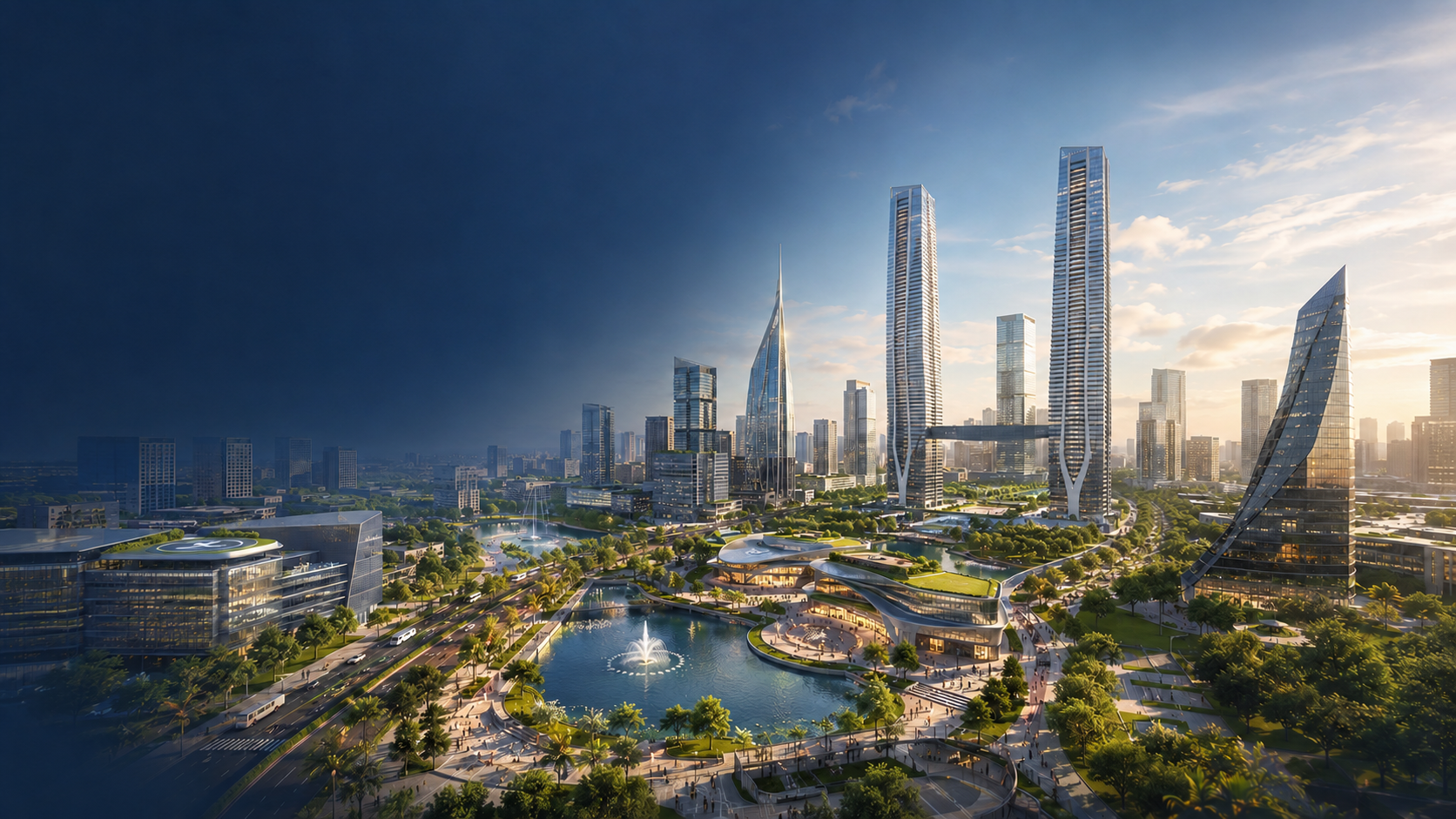
Gurugram has continuously reinvented itself over the last two decades.
Cyber City transformed the city into one of India's leading corporate destinations. Golf Course Road established itself as a premium residential and commercial address. Golf Course Extension Road, Southern Peripheral Road and Dwarka Expressway subsequently created entirely new real estate corridors.
Now, another large-scale development has the potential to reshape Gurugram's future urban landscape: Global City Gurugram.
Global City is a Haryana Government-backed mixed-use township being developed by the Haryana State Industrial & Infrastructure Development Corporation Limited (HSIIDC). The official project website describes it as a self-sustaining, smart, mixed-use destination bringing workplaces, residences, retail, social infrastructure, green spaces, water bodies and multimodal connectivity together within one planned urban ecosystem.
At approximately 1,002.36 acres with a planned built-up area of around 12.88 million square metres, Global City is considerably larger than a conventional commercial or residential project.
Its significance for property investors is therefore much broader than the development happening inside its boundary.
The bigger question is:
Can Global City create a new employment and business district capable of driving residential demand across Dwarka Expressway, New Gurgaon and adjoining micro-markets?
That is where its long-term real estate story becomes interesting.
Global City Gurugram is being developed as a large mixed land-use township by HSIIDC, the Haryana Government's nodal infrastructure development agency.
According to HSIIDC, the development has been conceptualised as a “City within a City”, combining business districts with residential, retail, hospitality, healthcare, educational and recreational infrastructure.
The official plan envisages approximately 12.88 million sq. metres of built-up area across 1,002.36 acres, including:
Rather than developing another isolated office district, the larger objective is to create a live-work-play ecosystem where employment, housing, shopping, entertainment and essential services coexist within one integrated urban centre.
Location is one of Global City's strongest strategic advantages.
The development extends across parts of Sectors 36, 36B, 37 and 37B of Gurugram. It enjoys direct accessibility from the 8-lane Dwarka Expressway, also known as the Northern Peripheral Road/NH-248BB, as well as Pataudi Road. NH-48 and the Central Peripheral Road are also located nearby.
An HSIIDC bid document states that the project has approximately 400 metres of frontage on Dwarka Expressway and approximately 700 metres of frontage on Pataudi Road, giving it access from two important sides.
This places Global City within the broader connectivity network of:
Dwarka Expressway → CPR → NH-48 → SPR → New Gurgaon → Manesar
That connectivity is important because a large employment district becomes considerably more valuable when employees can access it from multiple residential catchments rather than through one congested corridor.
HSIIDC's project documentation provided the following indicative travel times:
| Destination | Indicative Travel Time |
|---|---|
| IGI Airport, New Delhi | ~20 minutes |
| Cyber City | ~20 minutes |
| Golf Course Road | ~20 minutes |
| Gurugram Railway Station | ~15 minutes |
| HUDA City Centre area | ~20 minutes |
These are HSIIDC's indicative estimates, not guaranteed driving times; actual travel will naturally depend on traffic and road conditions.
The project's proximity to Dwarka Expressway is particularly significant because the expressway has already emerged as one of Gurugram's major residential development corridors.
Global City potentially adds something that every residential corridor ultimately needs: a large employment centre close to the housing supply.
The scale and planning philosophy behind Global City are what differentiate it from many conventional developments in NCR.
HSIIDC describes the project as a future Central Business District with an emphasis on modern technology-oriented businesses, transit-oriented development, ease of living and low-carbon infrastructure. The project carries an overall global FAR of 3.0, while individual mixed-use parcels can have different development parameters.
The master plan combines commercial development with residential and lifestyle components rather than concentrating exclusively on office buildings.
The idea can broadly be understood as:
Business + Residences + Retail + Hospitality + Education + Healthcare + Recreation + Green Infrastructure + Public Transport
This integrated approach has the potential to support a genuine walk-to-work environment, something increasingly valuable in a city where long daily commutes remain a major concern.
While high-rise buildings may eventually define the Global City skyline, some of the most important features of the project are actually being developed beneath and around those buildings.
HSIIDC has planned common underground utility tunnels for services including:
potable water, recycled water, electricity distribution, telecom and data networks, firefighting systems and automated waste collection infrastructure.
The advantage is straightforward: future maintenance or expansion of utilities can potentially be undertaken without repeatedly excavating major roads.
For a large business district expected to operate for decades, this type of infrastructure planning can be more important than architectural appearance alone.
Global City's internal road hierarchy is planned around a 60-metre arterial loop, supplemented by:
45-metre sub-arterial roads, 30-metre primary distributor roads, 18-metre secondary roads and smaller access streets.
A properly designed road hierarchy matters because traffic congestion eventually becomes one of the biggest challenges faced by successful commercial districts.
Building the road network before the district becomes densely occupied offers Global City an opportunity to plan mobility differently.
Global City's official infrastructure plan includes an approximately 6-km internal Mass Rapid Transit System with six stations.
HSIIDC states that approximately 80% of the planned residential and commercial areas would fall within a five-minute walking radius of these MRTS stations. The internal network is also planned to interchange with the broader Gurugram-Manesar-Panchgaon mass-transit corridor.
This is a significant part of the project's transit-oriented planning philosophy.
However, investors should differentiate between planned transit infrastructure and operational transit infrastructure. Future connectivity should therefore be evaluated on actual approvals, construction and commissioning progress rather than marketing representations alone.
Global City is also planned around extensive ICT-enabled infrastructure.
According to HSIIDC, the proposed systems include:
The intention is to manage infrastructure and public services through an integrated digital framework rather than treating each utility independently.
HSIIDC's official ecosystem plan indicates a peak power requirement of 646 MVA, supported by dedicated power infrastructure integrated with SCADA.
It also states that buildings within Global City are intended to be green-certified, with renewable-energy systems forming part of the sustainability strategy.
Water management is another significant component.
The plan includes wastewater treatment and reuse, a sewerage network, recycled-water infrastructure and a freshwater lake designed to function both as a storage reservoir or “aqua sponge” and as part of the city's public realm.
Waste management is similarly planned around a Reduce-Reuse-Recycle framework, including an underground automated vacuum waste collection system.
These features make Global City less of a conventional plotted business district and more of an attempt to develop a new urban ecosystem from the ground up.
This is the part prospective buyers should understand carefully.
On 12 August 2026, Haryana Chief Minister Nayab Singh Saini directed officials to prepare a special action plan to complete basic infrastructure facilities, including electricity and water supply, at Global City within the following three months.
A state statement reported that approximately 80% of the physical progress had been completed, with the remaining work targeted for completion by December 2026.
Interestingly, HSIIDC's earlier official pre-bid documentation had also stated that Phase 1 trunk infrastructure was expected to be completed by December 2026.
80% physical progress does not mean that 80% of the entire future Global City—its office towers, residential developments, hotels, malls and other private developments—is complete.
HSIIDC is developing the core or trunk infrastructure, including roads, utilities, drainage, power, water and other services. Individual land parcels can subsequently be developed by their respective allottees or private developers. Official HSIIDC auction documents specifically place responsibility for trunk infrastructure with HSIIDC while internal development of allotted parcels rests with the successful allottee.
That distinction makes the investment story much easier to understand:
Completion of infrastructure is the foundation of Global City—not the end of its development cycle.
Global City follows a model where HSIIDC creates the larger infrastructure framework and makes individual land parcels available for development.
Its official auction material has previously included substantial mixed-use parcels of 86.05 acres, 23.76 acres and 58.11 acres, along with institutional sites such as a school plot.
This development model matters because the ultimate character of Global City will depend heavily on:
which developers and corporations enter, what they build, how quickly projects are executed and—most importantly—how much genuine business occupancy is created.
Infrastructure can enable a business district.
Companies and people ultimately make it successful.
Global City is frequently compared with Cyber City, but they represent very different stages of urban development.
| Factor | Global City Gurugram | Cyber City |
|---|---|---|
| Current Stage | Developing | Mature & operational |
| Planning | Master-planned mixed-use city | Established corporate district |
| Residential Component | Significant | Limited in the core |
| Infrastructure | New-generation infrastructure planned | Mature existing ecosystem |
| Employment Base | Yet to develop at scale | Strong established corporate base |
| Investment Character | Future-growth story | Established premium location |
| Execution Risk | Higher | Lower |
Cyber City already has corporate occupiers, hotels, restaurants, rapid transit and an established workforce.
Global City's opportunity is different.
It has the ability to integrate business, residences, retail, technology, public transport and urban infrastructure from the planning stage itself.
Global City therefore does not necessarily need to replace Cyber City.
As Gurugram continues to grow, it can support multiple major employment districts—just as larger global cities operate with several commercial centres rather than one CBD alone.
The most important factor supporting sustainable residential demand is not a flyover, road or metro announcement by itself.
It is employment.
If Global City successfully attracts major corporations, technology businesses, financial institutions, professional-service companies, hospitality, healthcare and other employers, it could eventually create a substantial working population within this part of Gurugram.
And employment generates an economic chain:
Jobs → Housing Demand → Rental Demand → Retail → Schools → Healthcare → Hospitality → Services
That is why the success of Global City could influence property values beyond its own boundaries.
Dwarka Expressway has already seen major residential development and significant infrastructure investment.
Global City introduces the possibility of a new employment anchor directly connected with this corridor.
That is potentially important.
A residential corridor supported mainly by expectations of future appreciation behaves differently from a corridor that gradually develops:
offices + employment + residents + schools + retail + transport + social infrastructure.
If Global City develops into a major working district, the Dwarka Expressway story may increasingly move from being primarily an infrastructure-led market to becoming an employment-led residential market as well.
That would represent an important structural shift.
Global City's influence is unlikely to stop at the sectors immediately surrounding it.
Its connectivity with Dwarka Expressway, Pataudi Road, CPR and NH-48 means selected parts of New Gurgaon could also become relevant residential locations for people working within Global City.
However, investors should avoid treating the entire New Gurgaon market as one homogeneous investment opportunity.
Two properties located in the same broad corridor can perform very differently.
Factors such as actual driving distance, developer quality, project density, construction quality, surrounding infrastructure, maintenance standards, pricing and future supply will remain extremely important.
Potentially, yes—but this will depend on the quality of businesses that eventually establish themselves there.
If Global City succeeds in attracting multinational corporations, technology companies, financial institutions and large professional organisations, it can create demand from senior executives and affluent professionals seeking quality housing near their workplace.
This could favour premium residential developments offering:
larger apartments, premium clubhouses, landscaped surroundings, reliable facility management, strong security and easy connectivity to the employment district.
But Global City alone cannot make every nearby luxury project a good investment.
Developer quality and entry price still matter.
A strong macro-location cannot permanently compensate for excessive pricing, poor construction, extreme density or weak maintenance.
For long-term investors, Global City strengthens the broader investment case for parts of Dwarka Expressway and New Gurgaon.
But it should be considered one important component of an investment thesis—not the complete thesis.
A property should still be evaluated individually on:
Location: How easily can the project actually access Global City?
Developer: What is the builder's track record in delivery and maintenance?
Entry Price: How much future appreciation has already been priced in?
Supply: How many competing units will enter the same micro-market?
End-User Demand: Are people genuinely willing to live there?
Rental Potential: Does nearby employment support realistic rental demand?
Holding Period: Can the investor remain invested long enough for the ecosystem to mature?
The strongest infrastructure story can still become an average investment when purchased at the wrong price.
Global City may be particularly relevant to long-term investors willing to hold through the development of the employment ecosystem.
It can also be relevant for end-users planning to work along Dwarka Expressway, New Gurgaon or the wider Global City-Manesar corridor.
For NRIs, a large government-backed infrastructure and employment development can provide a useful macro investment theme, although the individual property still requires detailed due diligence.
And for commercial investors, Global City could eventually create interesting opportunities—but commercial investments need to be evaluated through tenant demand, absorption, lease rentals, yields and future supply rather than residential appreciation logic.
The Global City story now needs to move from infrastructure creation to economic activation.
Over the coming years, the most important indicators will be:
These indicators will tell investors far more than marketing campaigns describing a property as being “near Global City”.
Every emerging infrastructure-led market carries risks.
Global City is a large, long-term urban development, and creating a mature business district takes considerably longer than laying roads and utility networks.
Investors should consider possible delays in private construction, slower-than-expected corporate absorption, competing commercial supply elsewhere in Gurugram and residential prices that run ahead of actual rental or end-user demand.
Broader Gurugram infrastructure will matter too. Roads approaching the development, drainage, public transport and traffic management outside the Global City boundary will influence the success of the overall location.
For example, HSIIDC recently moved to reconstruct an important stretch of Pataudi Road connecting the Umang Bharadwaj Chowk side with the upcoming Global City area, including road, drainage and sewerage improvements—illustrating that surrounding connectivity continues to evolve alongside the township itself.
Global City is not simply another residential launch or commercial project.
At more than 1,000 acres, with approximately 12.88 million sq. metres of planned built-up area, it represents an attempt to create an entirely new economic and urban district within Gurugram.
Its planned combination of:
Dwarka Expressway connectivity + commercial development + residential development + public transport + smart infrastructure + social infrastructure
gives it the potential to become an important growth driver for this part of Gurugram.
But investors should keep expectations realistic.
The most important milestone is not simply when the roads or utility tunnels are completed.
The real turning point will come when Global City begins attracting businesses, offices, employees and residents at scale.
If that happens successfully, Global City could create a new employment centre capable of supporting residential demand across Dwarka Expressway and selected parts of New Gurgaon for many years.
For investors, therefore, Global City Gurugram is best viewed as a long-term structural growth story rather than a short-term appreciation guarantee.
And that may ultimately make it more significant than any single real estate launch around it.
Global City Gurugram is a mixed-use township being developed by HSIIDC, a Haryana Government-owned infrastructure development agency. It is planned as an integrated business, residential, retail and social-infrastructure district based on a live-work-play concept.
Global City is located across parts of Sectors 36, 36B, 37 and 37B of Gurugram, with direct accessibility from Dwarka Expressway and Pataudi Road. NH-48 and CPR are also nearby.
According to the official HSIIDC project website, Global City is planned over approximately 1,002.36 acres, with around 12.88 million square metres of planned built-up area.
No. As of August 2026, the Haryana government reported approximately 80% physical progress, with remaining core infrastructure work targeted for December 2026. This relates to infrastructure development and should not be interpreted as 80% completion of all future buildings within Global City.
Yes. HSIIDC states that Global City has direct accessibility from the 8-lane Dwarka Expressway and Pataudi Road.
The official plan includes an approximately 6-km internal MRTS with six stations, with an interchange envisaged with the wider Gurugram-Manesar-Panchgaon mass-transit system. These should be monitored based on actual implementation progress.
Global City has the potential to strengthen long-term employment and residential demand around Dwarka Expressway and New Gurgaon. However, an investment should still be evaluated based on developer quality, actual distance and connectivity, entry price, project specifications, future supply and intended holding period.
At Arban Realty, we believe infrastructure should be analysed for the economic activity it can ultimately create—not simply for the headlines surrounding it.
Global City Gurugram has many of the fundamentals required to become an important future business district: scale, government-backed infrastructure, Dwarka Expressway connectivity, mixed-use planning, transit-oriented development and proximity to established as well as emerging residential markets.
The opportunity, however, will vary significantly from one project to another.
For buyers considering Dwarka Expressway, New Gurgaon, Golf Course Extension Road, SPR or emerging developments influenced by Global City, selecting the right project at the right price remains more important than simply selecting the right corridor.
Looking to invest in Gurgaon real estate?
Connect with Arban Realty for research-led property advisory based on location, infrastructure, developer track record, pricing and long-term investment potential.
.png)